
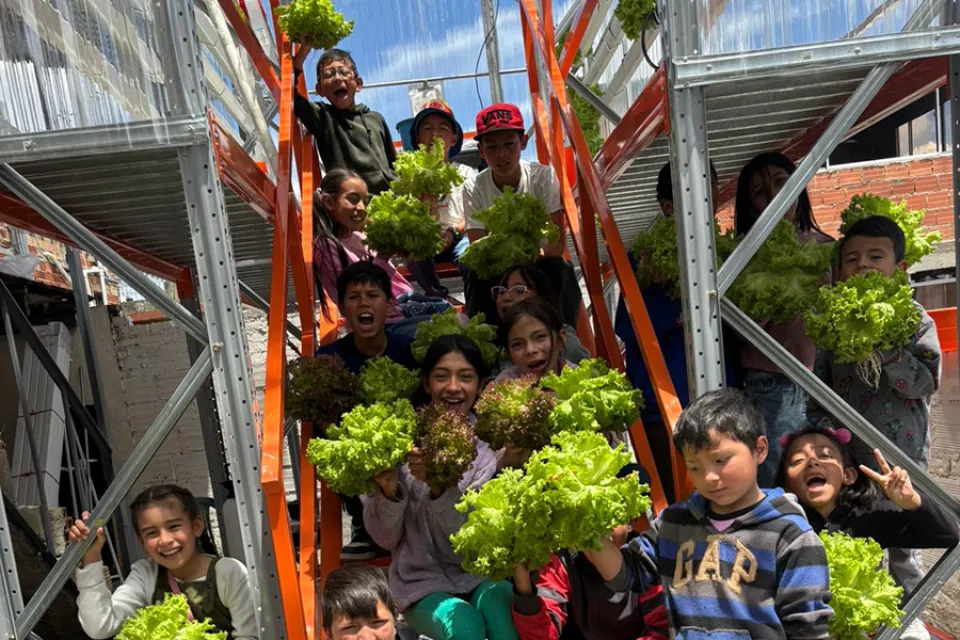
Urban agriculture has given me is an understanding how people, knowledge, and dreams come together in local community processes. Community comes together around a shared intention: to build community spaces capable of improving quality of life, strengthening relationships within the territory, and fostering a more conscious connection with the environment.
Urban agriculture and hydroponics are a fundamental part of this process. First as alternatives for local food production. Second, as educational and community tools to understand the relationship between water, food, and caring for our local territory. In a context where natural resources are increasingly limited and the effects of climate change are becoming more visible; these processes bring solutions closer to communities’ everyday lives.
Our proposal is about creating green spaces for urban agriculture, gathering, and collective building through community-built structures designed with care and respect for the spaces and conditions of the territory. We have already built such spaces. In them, we have develop activities related to nutrition, healthy lifestyle habits, agroecology, hydroponics, environmental education, and gastronomy, engaging more than 225 local children, their families and teachers.
Our vision is that these spaces become living platforms where the community can share knowledge, strengthen bonds, and experience new ways of relating to water, food, and the natural environment. The intention is for these experiences to inspire replicable and scalable processes in other sectors of the territory, strengthening community networks and promoting sustainable practices that can be sustained over time.
So far, this project has brought together different actors and organizations including: Maya Tejedores de la Tierra, Fundación Altos del Cabo, Huerta de los Pinzón, architect Alejandro Saldarriaga.
Currently, we developed two structures with the community. The first, built at Fundación Altos del Cabo, was awarded the highest design award in Colombia: Premio Lapiz de Acero. This demonstrates how architecture can become a tool to activate social, environmental, and educational processes. The second structure continues to strengthen this vision, integrating spaces for urban agriculture, learning, and community gathering.
The idea is to keep building settings where the community can meet, learn, and participate actively in caring for the territory—understanding that the relationship between architecture, water, agriculture, and community can become a real tool to strengthen quality of life and collective responsibility toward the environment.